
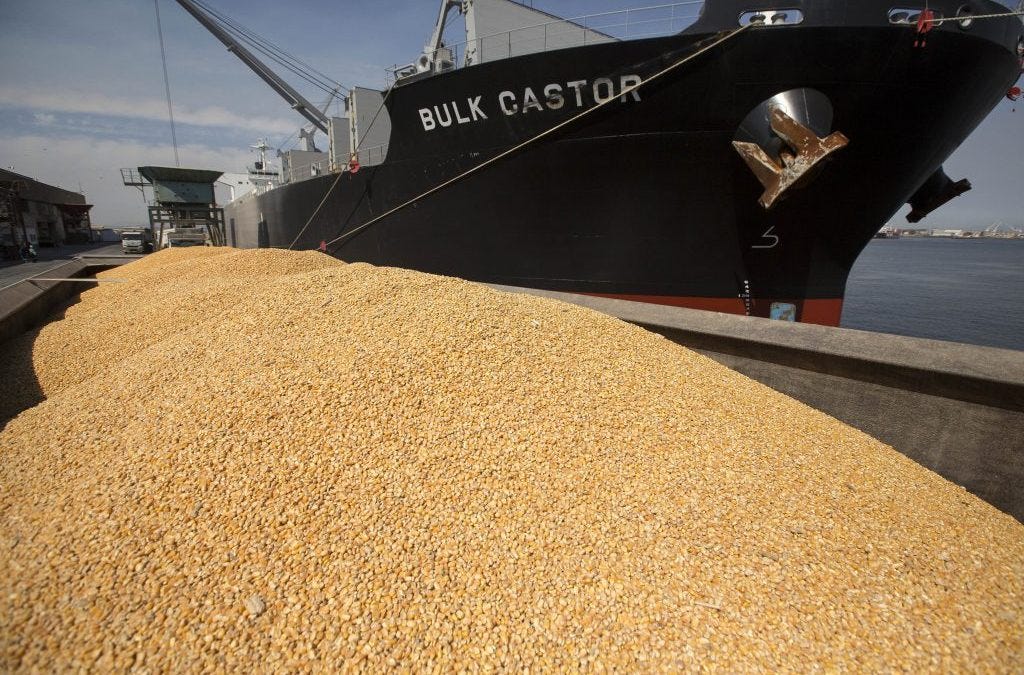
Our messaging about the importance of driving agricultural exports has, in the recent past, primarily focused on fruits, red meat and wine.
We didn’t mention grains and oilseeds much. Part of the reason is that the grains (mainly maize) industry is one of the most established agricultural industries, with generally stable export markets in the Southern Africa region and the Far East.
But as industry productivity rises and harvests continue to reach new record levels, we increasingly find ourselves with ample carryover stocks and not much demand for the grains.
Consider the maize industry: in the 2025-26 marketing year, which ended in April 2026, exports fell short of expectations. When the marketing year started in May 2025, we expected that by the end of April 2026, maize exports would reach 2.4 million tonnes, given South Africa’s ample harvest.
But as the year progressed, we encountered weaker-than-usual demand. By the time the 2025-26 marketing year ended in April, exports were only about 2.0 million tonnes, well below the industry’s conservative export forecast of 2.4 million tonnes set at the start of the season.
The typical buyers of South African maize in the Far East markets, such as Vietnam, Taiwan, and South Korea, were just not as active in the market. Rather, we saw strong demand for South Africa’s maize emanating from the Southern Africa region. In fact, Zimbabwe was the major buyer of South African maize, accounting for 39% of South Africa’s 2.0 million tonnes of maize exports. This was about 780,770 tonnes, primarily driven by a lower domestic harvest and growing demand. The volume included both white and yellow maize.
Amongst other things, the reason for lower demand in some of South Africa’s typical export markets, particularly those in the Far East, was ample supplies of more affordable maize in the world market. This lessened the need for imports from as far as South Africa.
Still, there is a lesson here: in promoting agricultural exports from South Africa, we can no longer take it for granted that maize will have a market. We have to ensure that the maize and entire grain industry is part of the export promotion agenda to a greater extent than in the past.
We have just started the 2026-27 maize marketing year from May 2026, and, as with the previous season, supplies are plentiful. South Africa’s maize production estimate is 16.8 million tonnes, up 1% from last season, and the largest harvest on record. This adds to already larger stocks from the previous year, placing South Africa yet again in a position to export large volumes of maize.
Our domestic maize consumption is about 12.0 million tonnes. If we consider the ample harvest of 16.8 million tonnes, and account for this consumption, and stocks we will need going forward, it would be fair to say that South Africa is in a strong position to export about 3.0 million tonnes of maize in the 2026-27 marketing year, which ends in April 2027.
We may see stronger demand from the Southern Africa region, as some countries are likely to face El Niño-related drought, reducing their harvests in the coming season.
But whatever strong demand we see from our region should not make us complacent; it is key that we continue to promote the maize exports. This industry is growing and well-positioned to continue driving exports.
In 2025, the maize industry accounted for 5% (US$760 million) of South Africa’s US$15.1 billion in agricultural exports. Overall agricultural exports reached a record level, up 10% year-on-year. This key industry must remain part of our agricultural export drive.
—Wandile Sihlobo is the Chief Economist of the Agricultural Business Chamber of South Africa (Agbiz). Email: wandile@agbiz.co.za and on X, at @WandileSihlobo