
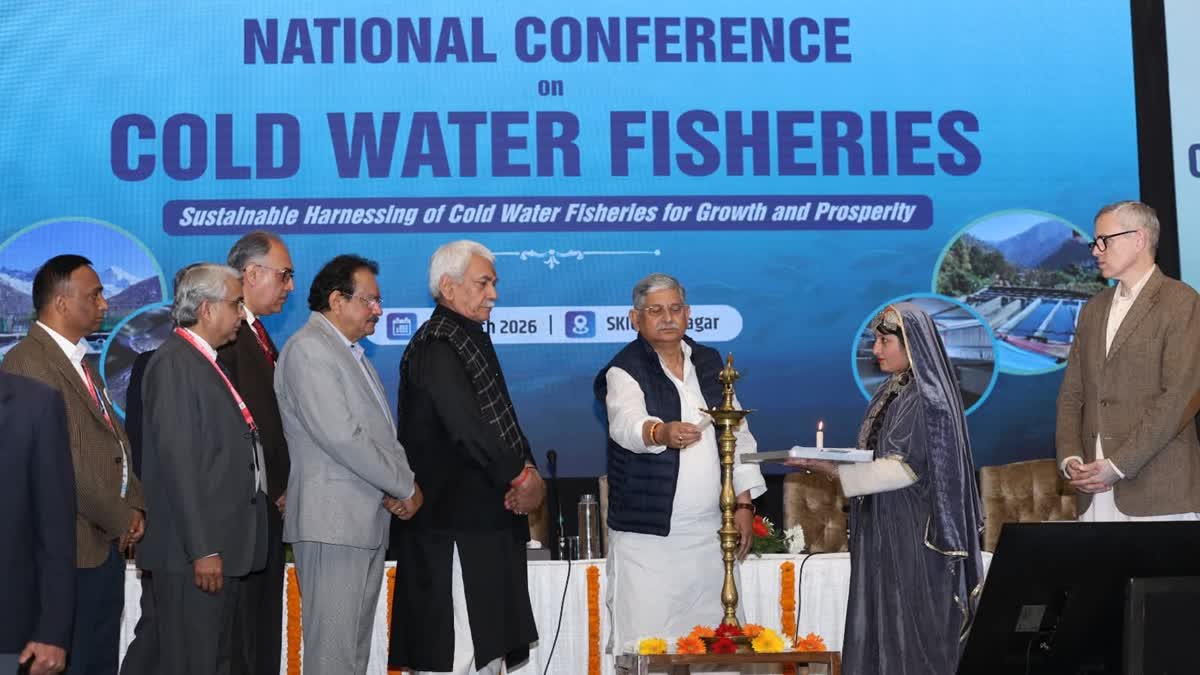
Union Fisheries Minister Rajiv Ranjan Singh(C) inaugurates National Conference on Cold Water Fisheries in Srinagar (ETV Bharat)
Srinagar: Union Fisheries Minister Rajiv Ranjan Singh said India’s seafood exports have continued to grow despite tariff barriers in the United States. He underlined the resilience of the country’s fisheries sector and expanding global demand.
Speaking at the National Conference on Cold Water Fisheries on Saturday at the Sher-i-Kashmir International Conference Centre (SKICC), Singh said India’s fish exports grew by about 20 percent in volume and 13 percent in value during 2025 compared with the previous year.
“When the US tariff was imposed, many believed the fisheries sector would be the most affected, particularly shrimp exports, because nearly 75 to 80 percent of our shrimp shipments go to the United States market. Our exporters were naturally concerned at that time. However, despite these challenges, our fish exports have continued to grow,” the Minister said asserting that the government had worked closely with exporters to explore new markets and strengthen value addition.
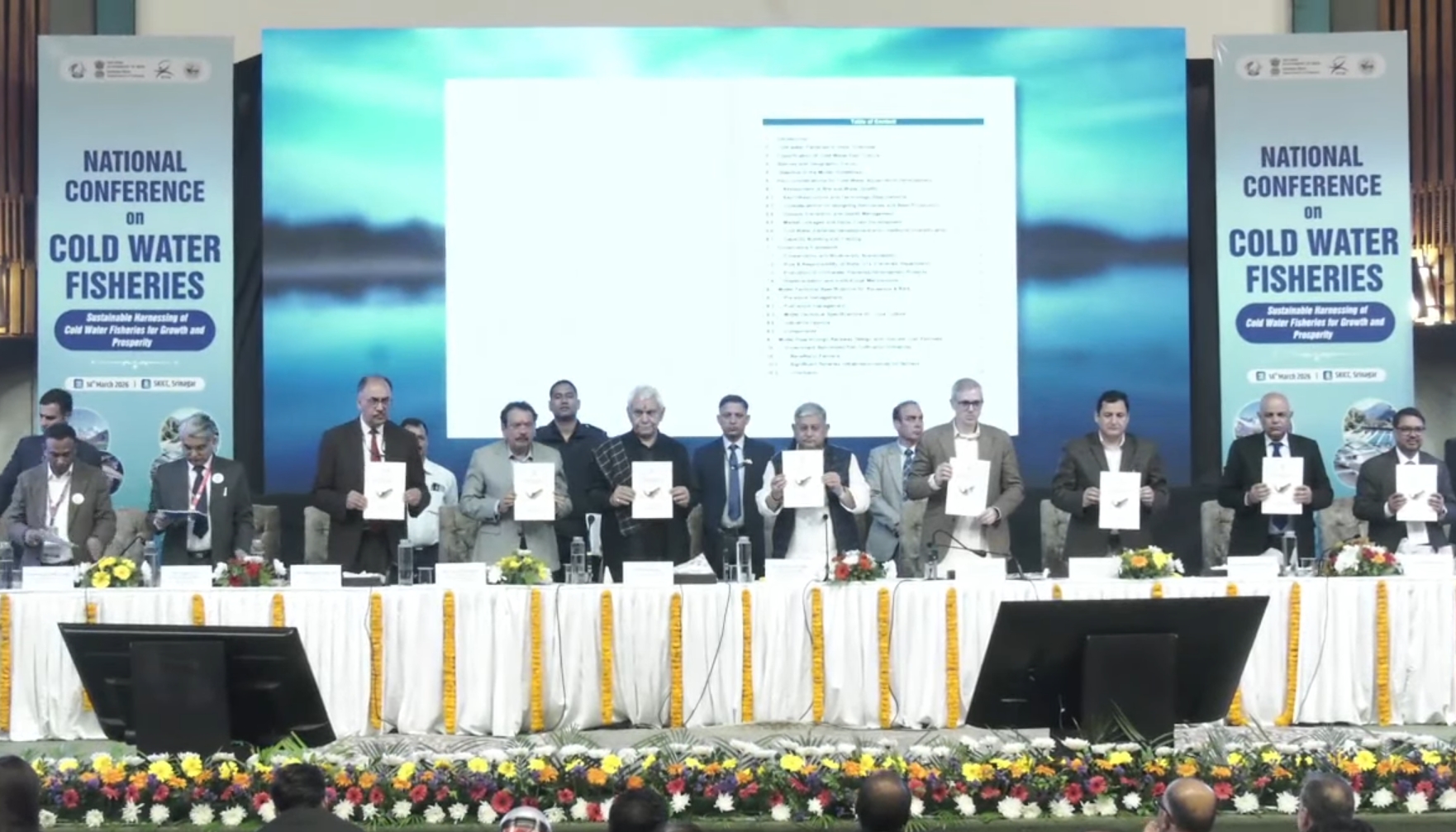
Rajiv Ranjan Singh Announces Rs 100-Crore Aqua Park In Kashmir (ETV Bharat)
While comparing with last year, the minister said: “…export volumes have increased by around 20 percent and the value has risen by about 13 percent, which shows the resilience of India’s fisheries sector and the growing global demand for our products.”
The conference, organised by the Department of Fisheries under the Ministry of Fisheries, Animal Husbandry and Dairying, brought together policymakers, scientists and industry stakeholders to discuss strategies for expanding cold-water fisheries in India’s Himalayan regions.
Singh said the decision to host the national conference in Srinagar was deliberate.
“Some suggested holding it in Dehradun or Shimla, but I insisted that it should be organised in Srinagar because Jammu and Kashmir has enormous potential in cold-water fisheries,” he said.
The minister highlighted species such as trout and mahseer as key drivers of future export growth. These cold-water fish varieties thrive in temperatures between 5°C and 25°C and are mainly found in Himalayan regions including Jammu and Kashmir, Himachal Pradesh and Uttarakhand, as well as parts of the Northeast and southern highlands.
Addressed the National Conference on Cold Water Fisheries at the Sher-e-Kashmir International Conference Centre (SKICC), Srinagar, reaffirming the Government of India’s commitment to strengthening the fisheries sector in Jammu & Kashmir through sustained policy and infrastructure… pic.twitter.com/OfNdLSllIS
— Rajiv Ranjan (Lalan) Singh (@LalanSingh_1) March 14, 2026
“These species have strong global demand and offer good export potential,” Singh said, urging farmers and entrepreneurs in Jammu and Kashmir to expand production.
He credited policy initiatives launched under Prime Minister Narendra Modi for strengthening the fisheries sector. Since 2015, the government has launched several programmes, including the Blue Revolution, the Fisheries and Aquaculture Infrastructure Development Fund and the creation of a separate fisheries ministry in 2019.
As a result, India is now the world’s largest milk producer and the second-largest fish producer. Annual seafood exports have also grown sharply, rising from about Rs 30,000 crore before 2015 to around Rs 65,000 crore in recent years.
New opportunities in deep-sea fishing
Singh also outlined new initiatives aimed at expanding marine fishing beyond coastal waters.
The government has allowed Indian fishing vessels to harvest high-value tuna in the Exclusive Economic Zone (EEZ) and the high seas up to 200 nautical miles. Earlier, fishing operations were largely restricted to areas within 12 nautical miles of the coast.
“Global demand for tuna is very high and it is one of the most valuable fish in international markets,” Singh said.
To regulate the activity, only vessels flying the Indian national flag will be permitted to fish in these waters. The government has already begun issuing access permits to fishing groups and cooperatives.
Singh said more than 3,000 applications for such permits had been received, indicating strong interest from the sector.
The government has also amended earlier rules so that fish caught by Indian vessels in the high seas and landed at domestic ports will not be treated as imports. If the same catch is landed directly at foreign ports, it will count as exports.
Singh also announced a Rs 100-crore integrated aqua park in Kokernag in south Kashmir. “Before coming here, a few days ago I approved an aqua park in Anantnag (Kokernag).”
The facility will support the entire trout production cycle, including broodstock management, hatcheries, processing and marketing infrastructure.
Singh also proposed establishing a regional office of the National Fisheries Development Board (NFDB) in Srinagar to promote exports and support local fish farmers.
He urged the Jammu and Kashmir government to encourage fish farmers to form cooperatives and farmer producer organisations so they can access government schemes and financial support.
Inspiration from a young entrepreneur
During the conference, Singh highlighted the work of Aditya, a young entrepreneur from Hyderabad who has successfully developed a trout farming venture in the southern city’s warmer climate.
The minister said the youth, an IIT graduate, spent months living at his farm while building the venture from scratch.
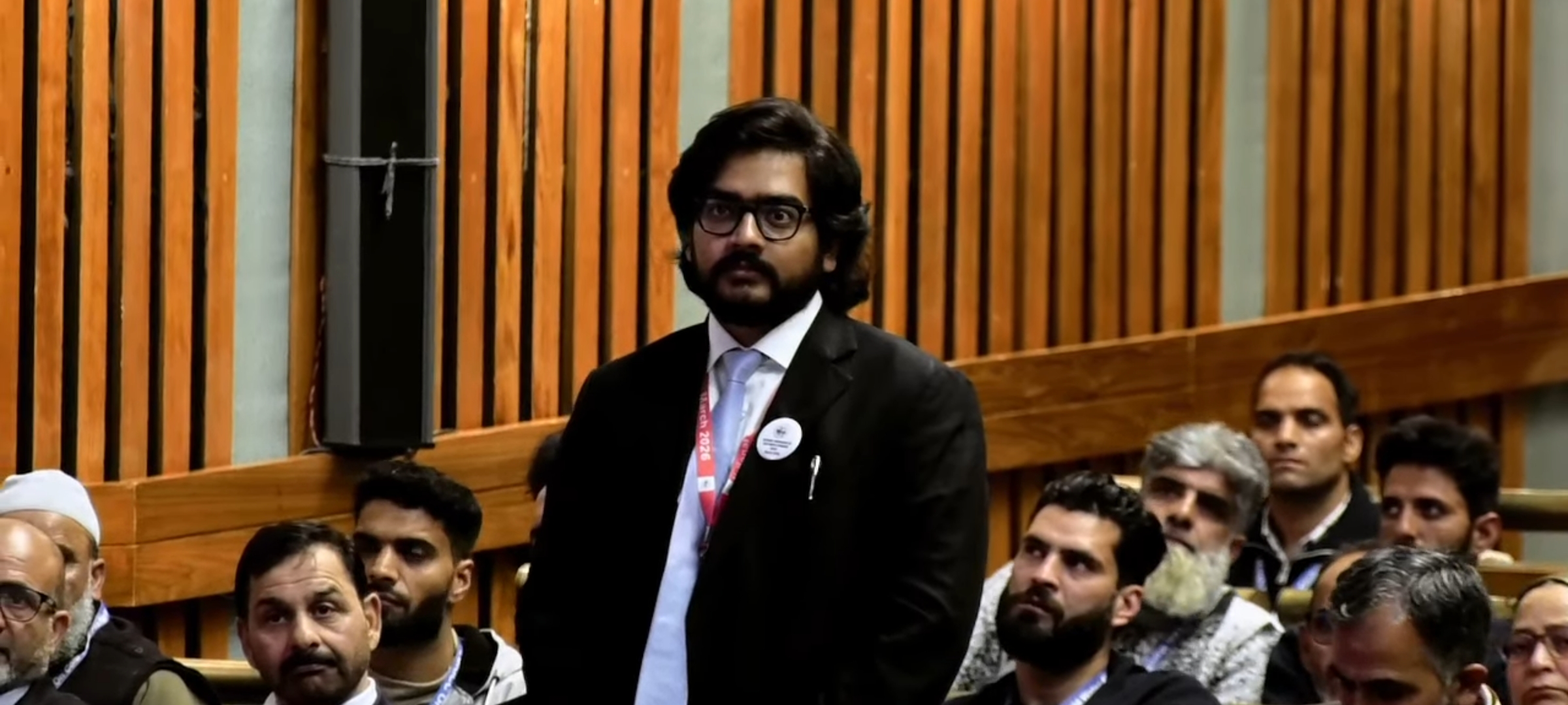
An entrepreneur speaks at the National Conference on Cold Water Fisheries in Srinagar (ETV Bharat)
“His dedication shows that young people can build successful businesses in aquaculture with determination and innovation,” Singh said, urging others to draw inspiration from such efforts.
Addressing the gathering, Jammu and Kashmir Lieutenant Governor Manoj Sinha said the region has the potential to emerge as a national model for integrated fisheries development.
He said the sector contributes about 7.3 percent to India’s agricultural GDP and exports have doubled since 2013-14.
Sinha said initiatives under the Holistic Agriculture Development Plan have already boosted trout production in the Union Territory, which increased from 1,663 tonnes in 2021-22 to about 2,650 tonnes in 2024-25.
The region currently uses nearly 27,000 hectares of water resources for fisheries development.
Sinha also highlighted challenges such as climate change, rising water temperatures and fish health risks, stressing the need for scientific research and climate-resilient production systems.
He said innovative logistics solutions such as drone-based transportation of fish from high-altitude farms were also being explored to reduce spoilage and improve supply chains.
Chief Minister Omar Abdullah emphasised the importance of scientific research and sustainable practices in expanding cold-water fisheries in the region.
He said universities and research institutions must play a larger role in developing modern techniques to revive and expand the sector.
“Science and research must guide how we strengthen cold-water fisheries while protecting our natural ecosystems,” Abdullah said.
The chief minister also pointed to the effects of climate change in Kashmir, noting that warmer winter temperatures have already begun altering natural cycles.
He cited the unusually early blooming of flowers this year and the early opening of the Indira Gandhi Memorial Tulip Garden as signs of changing weather patterns.
Abdullah said such changes could affect cold-water fish habitats, making innovation and adaptive practices essential.
He also noted that Kashmir has more than a century of experience in trout farming since the species was introduced in the region in 1900.
“Our long experience of 126 years should not go to waste. We must share our knowledge and also learn from other states,” he said.
The chief minister welcomed delegates from Himalayan and northeastern states and expressed hope that collaborative efforts would help strengthen India’s position as a leading fish-producing nation while ensuring sustainable growth in Jammu and Kashmir’s fisheries sector.
Read More: