
Since your company is a trading house, I would first like to focus on the export side. Japanese food exports are expanding, and trading companies play an important role in that growth. Looking ahead, Japanese food exports seem likely to change significantly. They have been steadily increasing and continue to be renewed and updated. What do you think are the key factors and background driving this trend, and how do you see it developing from here?
I believe the increase in consumption of Japanese food is the result of multiple factors coming together at the same time. One major factor was a government initiative that began in 2003, when the Koizumi administration launched the Visit Japan Campaign. The government set clear targets, and the broader intention was to increase inbound tourism substantially. That was one important driver because it strengthened global awareness of Japan and created many more opportunities for people to experience Japan directly.
At the same time, Japan’s economy has not grown dramatically in recent years, while the economies of neighboring countries have expanded rapidly. As that gap narrowed, it became easier for more people to travel to Japan. When those visitors came to Japan and experienced Japanese cuisine, many discovered how delicious, refined, and carefully crafted it is. As more people had that firsthand experience, more of them began to want to eat Japanese food again when they returned home, and some began to think seriously about building businesses around Japanese cuisine overseas.
So if you ask me what the foundations are, I would say there are two big themes. One is the government’s push and the broader national effort that encouraged inbound tourism. The other is the economic background in the region that made travel more achievable and increased the number of people who could experience Japan directly. Together, those factors created a cycle. People come, discover Japanese food, and then create demand abroad, either as consumers or as business operators. That is why I believe Japanese food exports will continue to increase from here.
However, there is an important condition. If we want this growth to accelerate further, especially for fish and seafood, we have to recognize what makes Japanese food unique and difficult to replicate. Japanese seafood has seasonality, and it also has an extraordinary diversity of species and varieties. And when we say “Japanese cuisine,” it is not only the seafood itself. In Japan, even sashimi is presented with garnish and supporting elements, and behind that are essential ingredients such as dashi and other components that complete the experience. Japanese cuisine is a full package, not simply “sushi” as a single item.
If local people overseas do not receive proper training and do not truly understand what Japanese cuisine is trying to express, then the real taste cannot be delivered through exports alone. This is why people sometimes talk about “imitation Japanese food.” If we want to grow the market in a healthy, sustainable way, then developing talent and building professional capability in overseas markets becomes critical. We must nurture people who can understand Japanese cuisine deeply and work with it seriously.
Even today, I believe there are still not enough trained professionals to fully cover the market. And if we want the market to expand further, we will need even more people with the right knowledge and skills. Otherwise, the risk is that untrained, unprofessional operators become involved and the authentic taste and value of Japanese cuisine cannot be communicated properly. That is a key challenge for Japan as we think about the future.
Let me confirm that I understood correctly. Japan has not grown dramatically recently, while neighboring countries have grown significantly. The gap has narrowed, making it easier for people to come to Japan and experience Japanese food and culture. There are two main elements: the government campaign and the economic environment, including the increase in inbound visitors and rapid growth in neighboring countries. As a result, more people try Japanese food and want to eat it again, and more people want to turn it into a business, so exports will keep increasing. Is that correct?
Yes, that is the core of it. As neighboring economies grow at a very fast pace, more people visit Japan, try Japanese cuisine, and then want to eat it again. Some also want to develop it into a business in their own countries. That is why I believe exports will continue to grow.
But again, the condition is talent and capability. If we want to expand further, especially in seafood, we need people overseas who truly understand Japanese cuisine and can handle it professionally. Without that, we cannot deliver the real experience, and we cannot expand in the right way.
I would like to ask directly about your company’s role. In overall agricultural production, processed foods account for a large share, while agricultural products and fish and meat are a smaller portion. Your company supplies items such as wagyu and products from Toyosu Market, and you handle many categories including agriculture and seafood. How do you see the role of a company like yours in bringing agriculture and broader production to global markets?
When people go to a Japanese restaurant, whether in Japan or overseas, what they really want is not simply a fixed set menu. They want what is most delicious in that season, on that day. Japanese cuisine is built around that idea, that “this is what tastes best right now.” That seasonal sensitivity and ability to recommend what is truly best today is essential.
This is why our strength is not simply purchasing and shipping what happens to be available at Toyosu. Our strength is what Japanese people call mekiki, having the trained eye and professional judgment to identify what is excellent, what is in peak condition, what will deliver the right experience, and what will not. Tuna is a good example. It is not enough to say “tuna.” There are differences in quality, condition, and suitability, and you need professional judgment to select correctly.
That is our value. We propose what is truly delicious today and deliver that to customers overseas. Many companies operate at Toyosu and export products, but their levels vary significantly. Some have deep knowledge of seafood and handling, and some do not. Logistics and distribution are also highly technical. Different items require different temperature control to maintain top quality. It is not simply “keep it cold.” You need to know the right temperature for the specific product and manage it through the entire value chain, including handling after arrival. That know how is complex, but it is essential for quality.
At Toyosu, when you say “the level differs,” do you mean the overseas buyers coming to purchase, or do you mean the operators and wholesalers handling the products for export?
I mean the professional operators, the companies handling and exporting the products. Their knowledge and capability varies.
So among the wholesalers and exporters at Toyosu, the level differs. Some companies know far more about seafood, some know less. And on the distribution side, there is specialized know how, such as managing different temperatures for different items, and thinking across the entire value chain to maintain quality. Is that correct?
Yes, exactly. The differences are primarily among the professional operators handling and exporting the products, and that knowledge determines whether the final customer receives excellent quality or not.
You mentioned you are specialized and have the capability to identify which product will be best seasonally. Which products are you actually specialized in? When you go to Toyosu, what products does your team usually focus on?
Everything. We have very experienced people. They are trained.
You also mentioned you have a sushi restaurant since 2014. Thank you very much. You have a sushi restaurant and you train everyone there. What does that allow you to do, practically speaking?
Even though we are a trading house, especially for the staff working in the export department, we train them for a few years at Toyosu Market. In addition, since 2014 we have operated a sushi restaurant, and everyone receives training there as well.
As a result, the staff in the export division can speak Japanese, understand seafood, and can even make sushi themselves. This is not common in many trading companies, but it gives us a real advantage. It means we can understand the perspective, standards, and even the emotions of chefs and food professionals overseas. Because we understand how they work and what they need, we can export seafood in a way that fits their requirements and supports their success, not simply ship product as a commodity.
That is interesting. When you talk about the value chain, I am reminded of my own experience. I am from central France, about 45 minutes from Rungis, which is considered the largest food market in the world. My uncle has a small restaurant, and I have gone with him to Rungis to see products and decide what we would select for that day. I am curious what experiences you have seen with your customers, especially chefs who want to experience washoku. How do you help them directly? How do you attract them, and how do you explain what products they should choose?
I understand. And because your uncle has a small restaurant, you know how difficult it is.
Basically, we have our own staff based in each country, including across Oceania, and they communicate directly with local chefs. In addition to our own companies, we also have partner companies in different cities, and together we build direct relationships with chefs so we can explain products clearly, suggest the right items, and provide ongoing support.
We also often bring chefs to Japan. We go to Toyosu together. We take them to sake breweries. We visit farms as well. By doing these visits together, we can build a shared understanding of what they are looking for, and we can also show them the real foundations of Japanese cuisine, including production sites and craftsmanship. Through this kind of exchange, it becomes much easier to understand each other’s expectations and to work together successfully.
Just to confirm, you said Toyosu, sake breweries, and what was the other place you mentioned, farms?
Yes, farms as well. We visit farms, in addition to Toyosu and sake breweries.
And once those relationships deepen, chefs request items beyond Toyosu, such as vegetables from specific farms or sake from specific breweries, so the number of items expands, correct?
Yes. The portfolio expands naturally as their requests become more specific. A recent example is miso.
You mean Saikyo miso, the best miso?
Yes, Saikyo miso. We had a request for it, and we arranged introductions. There was a French restaurant group connected to the request, and we invited them together. The producer is based in Kyoto, and recently they purchased a significant amount. I also studied how to use it properly and worked together on preparations so it could be introduced and developed in their business. When those chefs come to Japan, we can do that kind of work together in a very concrete way.
The Reach Group? Is that the name of the group you are referring to?
Yes, that is the name that came up in that context.
Which regions do you think are currently underdeveloped for you, and where are you looking for partnerships?
We would like to expand further into North America and South America. In South America, Brazil is particularly important.
Is that about imports, or exports?
Exports.
When you pursue North America, South America, and Europe, how do you think about the route to enter those markets? Do you begin by building cooperation with local distributors and restaurants, or do you plan to go deeper and establish your own presence?
For the United States, we believe partnerships with local distributors are necessary. At the same time, many Japanese companies are already operating in the U.S., and we already have transactions with some of them. We supply products to Japanese restaurant groups operating there. So in the U.S., we support those customers through our existing structure, and then expand by building new relationships with additional restaurant customers.
For South America, we actually have a procurement base in Chile. In South America, Spanish is necessary, and Portuguese as well depending on the country, and we believe we are using that base effectively to expand our operations.
South America expansion, specifically, you mean expanding your export activity there, correct?
Yes, expanding in South America as well.
Since there are many Japanese people in Brazil, around 300,000, I think that could be a strong transition point. I have one more question. As you said, in the U.S. you would like to establish a subsidiary. When do you think you can realize that, and what is the timeline?
As I mentioned earlier, the key issue is people, human resources. Our company is not the type of company that simply hires senior executives from outside and scales quickly in that way. We are a company that develops people internally. We invest time to train and build the right talent.
So if we can develop people who are ready to lead that kind of initiative, then we can do it at any time. In other words, the timeline depends on when we have the right people prepared.
I understand. It may be “anytime,” but human resources are the constraint. You prefer to develop people internally rather than bringing in a ready made headquarters team. So it may take time, but once you are ready, you can move. Is that the correct understanding?
Yes, exactly. People are the key. Talent development takes time. But once we have the right capability, we can execute.
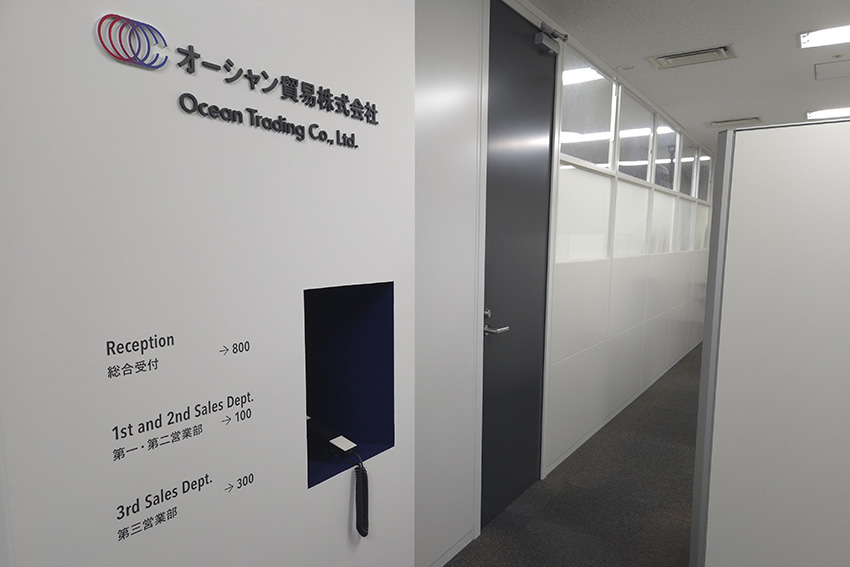
Head office
I would like to shift slightly. Your company is not simply a seller. It is a diversified trading company. In Japan, you have achieved something impressive. You partnered with a Norwegian company and supplied salmon into Japan’s sushi restaurants and consumer markets, and you have built many achievements. How would you define your company, and how would you explain your achievements, including the expansion of Norwegian salmon?
One major milestone for us was the decision that we needed to do export as well, not only import. At that time, our partner in Norway was a company called Leroy Seafood, which is a very large Norwegian company, among the world’s top producers, second or third globally depending on the ranking.
They had many sales subsidiaries in the United States and Europe. We began with the idea of exporting Japanese buri, or hamachi, using their overseas sales network. Because Leroy already had distribution capability in the U.S. and Europe, we thought we could export hamachi into those markets through their structure. That was a key insight, and that is how our export business began.
So you were selling hamachi to Leroy Seafood’s overseas sales subsidiaries?
Yes. At the same time, we were already buying a large amount of salmon from Leroy. Because we had an existing business relationship, it was easier to ask them. We already had trust and transactions in place. So we could say, “We want to send Japanese fish to the U.S., can you support us?” That was an important point.
You also mentioned building a company and operations in Vietnam, and you compared it to building a farm, where it takes years before you see results. Can you explain what happened in Vietnam and how it contributed to your expansion?
Because I travel frequently, I saw that the seafood level in Ho Chi Minh City was very low at that time. I felt that if we established an Ocean Trading style operation in Ho Chi Minh, we could succeed. So around 2009 we established a company there.
A company in Vietnam for imports?
Not exactly only for imports. We established an Ocean Trading style company in Vietnam, and from there we began operations that supported exports as well, including hamachi exports. That experience became one major foundation for our expansion across Asia.
Southeast Asia is highly connected. Many Singaporeans, Malaysians, and Indians come to places like Ho Chi Minh. As people observed our operation, they began to request similar models. They said, “Teach us how to import fish in Malaysia as well.” “Let us do this in Indonesia.” “Let us do this in Singapore.” That kind of demand spread.
At that time, the market in Japan was still Tsukiji, not Toyosu. We opened an office near Tsukiji, trained staff through hands on learning there, and gradually began specialized export operations. That became a major trigger for our export expansion. At the same time, the broader economic environment also evolved, including the increase in inbound tourism. Those factors intertwined and supported growth.
Thank you. Now, about Southeast Asia. Many companies handle shrimp in Singapore and Malaysia, but you are aiming to become a central player in Southeast Asia. Over the next three to five years, what growth do you expect?
We see Singapore as the central hub for Southeast Asia. Many companies and people are based there. We expect supply to major supermarket chains to increase significantly, and we see that as one core driver.
We also expect sales into Taiwan to increase, particularly for shrimp. Over the next three to five years, supply from Japan into Southeast Asian markets is likely to increase substantially.
In addition, we have supply chains that we currently use to bring products into Japan, such as products from Norway, Alaska, and South America. We expect more of those products to flow into Southeast Asia as well, using Singapore as a hub. In other words, we can leverage the supply chain and distribution capabilities we already have and expand those flows into Southeast Asia and surrounding markets.
Just to confirm, you mean products from Norway, Alaska, and South America can be moved through your existing supply chains and then expanded into Southeast Asia, correct?
Yes, that is correct.
So you want to use Singapore as a hub and expand distribution into Southeast Asia, including supplying local supermarkets such as Giant, Cold Storage, Sheng Siong, and NTUC, and also expand into Taiwan. You also want to leverage your existing supply chains into Japan and extend that network into Southeast Asia through your platform. Is that correct?
Yes, that is correct.
This is my final question. Newsweek is one of the most recognized media outlets among a very large readership domestically and internationally. Many Asian restaurants, overseas distributors, and partners will read this. If you had to define your company in one phrase to all of these distributors and partners, how would you define it? What kind of company are you, in one sentence?
We work with many countries around the world, and in a sense we are constantly negotiating, sometimes even fighting in the competitive reality of global business. But if I must describe us in one phrase, it might make some people smile, but I would say we are a company with magokoro.
Magokoro means sincere, genuine heart. Real business, real training, and real relationships do not last unless there is sincerity and true commitment on both sides. When we train people, it only works if the other person accepts it and shares that intention. When we handle products, the goal is not simply to profit in the short term. It is to handle truly good products properly, with respect, and to deliver quality in an honest way. That approach requires magokoro.
In English, how should we say that?
I would say, a company with sincerity, or a company with genuine heart. As a Japanese company, we value trust deeply. We value long term relationships, mutual benefit, and what we call sanpo yoshi, meaning business should be good for the seller, good for the buyer, and good for society. So we do not only talk about training. We focus on supplying high quality products responsibly, and we engage with partners sincerely, through real interaction and real commitment.
Wonderful. You provide the best ingredients each season, and that is truly impressive training and professionalism. Thank you very much for today’s interview. Your message is clear for the Japanese food industry and beyond: to deliver food properly, you must know what is truly good on that day, you must train people, you must choose correctly from the market, reflect seasonality, and deliver the highest quality. That ability to judge and select is one of the core strengths of your company. Your words are powerful, and thank you for sharing them for this feature.
Thank you very much.
For more information, visit their website at: https://www.oceantrading.co.jp/en/